RefE-873
Entered
Figures5 min · 936 words
Working paper
AI in the Boardroom: 49% of Boards Now Redrawing Human Decision Lines
49% of boards are reviewing which decisions stay human as AI moves from notetaker to sparring partner — while half of U.S. firms lack any board AI policy.
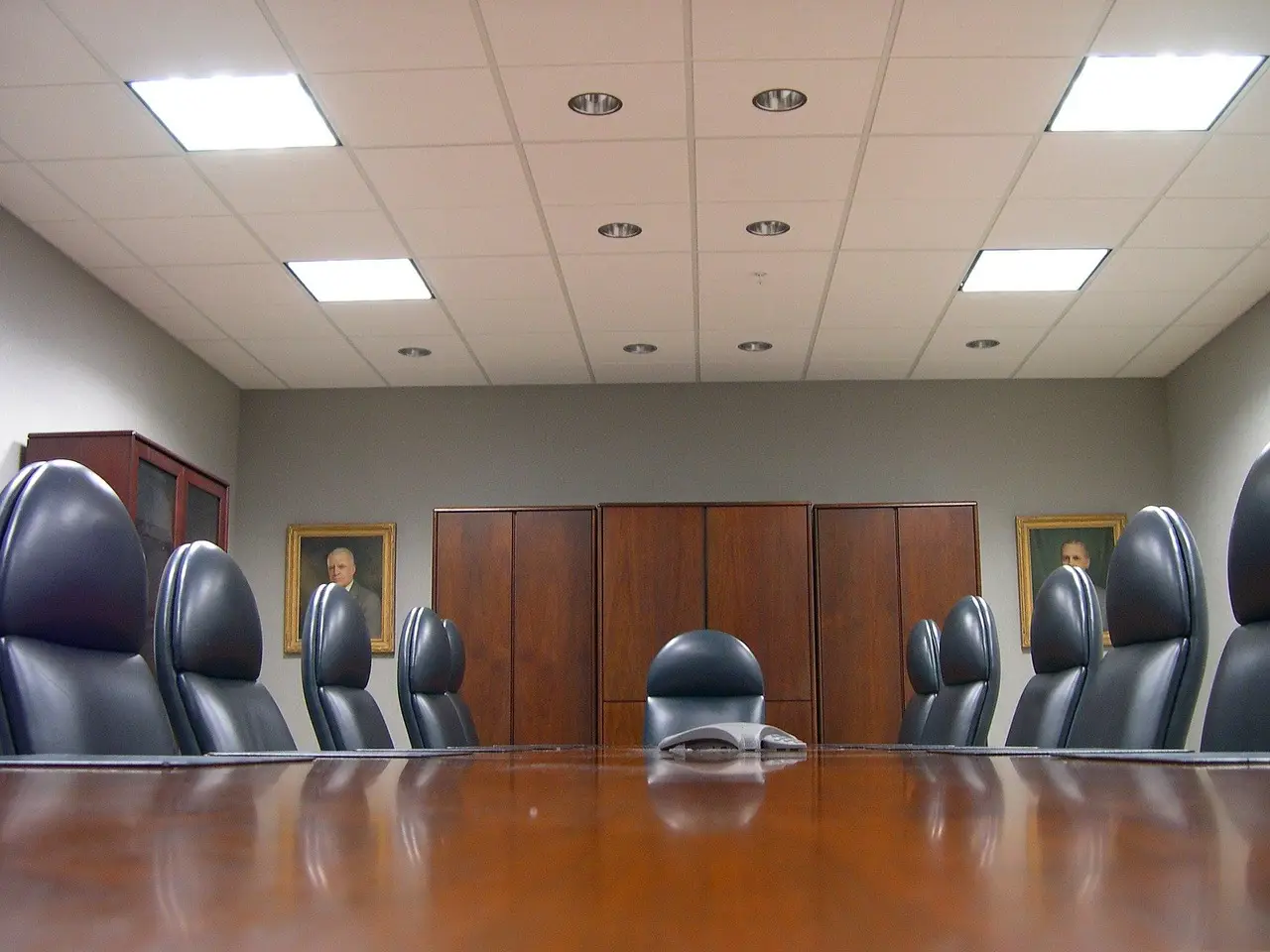
Nearly half of directors — 49% — say their board is actively reviewing which decisions should stay in human hands as AI capability improves, according to a Board Intelligence survey of more than 400 directors, CEOs and CFOs. That number frames the boardroom question finance leaders now face: not whether directors will use AI, but where its influence stops before legal accountability begins.
The shift from tool to participant is already visible. In April, Lloyds Banking Group became the first FTSE 100 firm to confirm it deploys an AI agent to support boardroom activities, The Times reported. Executives and directors there use the bot for agenda planning, pre-meeting analysis and bias mitigation.
Brian Stafford, chief executive of Diligent, the software maker whose platform directors use to share documents and run meetings, has heard where CEOs want this to go. When he described Diligent's new board bot to one chief executive, the reply was blunt: "I love the idea. I'd immediately replace a couple of my board members with AI." The CEO then asked whether the bot could be priced at half what he pays his directors, adding: "I want to make them nervous."
What can AI actually do at the table?
Joanne McEnteggart, global head of debt, capital markets and corporate at IQ-EQ — a fund-services firm administering roughly 30,000 board meetings a year across 25 countries — lays out the case. "AI can assimilate information quickly and dissect years of data," she says. "It removes emotion, stress, and bias, and can call out a director who seems to be deciding against the facts." Some boards have even used it to break deadlocks, a role traditionally played by the chair.
Current use is more mundane: summarizing board papers and tidying minutes. Even that changes behavior. One director McEnteggart has known for years now asks questions they never would have asked before. "That's good," she says, "because it challenges thought."
Boards are also deploying AI as a sparring partner. One chief executive uses it to play an activist investor; at one acquisitive company, a director asks the AI to argue against every deal. Stafford says this removes "awkward" human friction. He also sees AI specialists — a Middle East expert, a sustainability expert, a futurist — reducing reliance on external advisors.
Pippa Begg, chief executive of Board Intelligence, which builds AI software for boards, sees a future where AI sits in meetings and is "able to almost interrupt and say: 'Hang on, I think you're falling into this trap.' Or: 'I disagree.'" A formal legal vote, she added, would be "a dangerous leap."
Where has a bot actually been given a vote?
Kazakhstan's sovereign wealth fund, Samruk-Kazyna, appointed an AI board member called SKAI with voting rights last year. Its chief executive says SKAI "voted on all the items" at its first meeting — but the country's financial regulator says the appointment breaches national law. SKAI remains on the board as a pilot, a recent filing shows.
Abu Dhabi's International Holding Company, the UAE's largest listed firm, gave a non-voting board seat to an AI called Aiden Insight, which has issued statements describing itself as "a C-level AI entity." Mark Freebairn, head of the board practice at search firm Odgers, knows of boards that have given a bot a seat and a vote, though it remains "very uncommon" — and it means "accepting a robot adds as much value as a human."
What is the governance gap?
The policy deficit is measurable. Half of U.S. public companies lack a board-specific AI policy, and only 14% provide directors with company-approved AI tools for board work, according to Deloitte and the Society for Corporate Governance. A separate 2025 Deloitte survey of nearly 700 respondents in 56 countries found two-thirds of directors and executives say their boards have limited or no AI knowledge.
The exposure is concrete. Board papers routinely contain unannounced deals, unpublished results and succession plans. Many directors are retired executives without enterprise AI access, so they fall back to consumer chatbots with weaker data protection. Upload board papers to ChatGPT, Stafford warns, and it will have them "forever."
Freebairn cautions against assuming AI impartiality: people believe it decides with "zero emotion, zero human risk of bias," yet "how can you test what an algorithm tells you is right?" He also sees groupthink risk — "I sometimes feel like I'm the only person that's seen Terminator 2."
Law sets the hard limit. "A bot cannot be held personally responsible in law nor can anyone vouch that it is fit and proper to sit on a board," McEnteggart says. Deanna Strable, chief executive of Principal Financial Group and an Elevance Health director, doubts mainstream adoption: "My gut answer would be no. But so much has happened in the past year." If it comes, she expects an advisory vote, not a decisive one.
Research points the same way. In a test by Wharton and INSEAD researchers, a board of AI chatbots outperformed six human boards on decision quality and use of evidence but struggled to build trust; the researchers concluded AI is better used to stress-test a board's thinking than to replace it. Even the CEO selling the bot urges restraint: "AI slop is a big issue. More is not always better. It is just more."
For CFOs, the practical takeaway is a controls question: seven in ten large European companies now have defined board oversight of AI, per proxy advisor Glass Lewis — but that covers corporate use, not what directors themselves do with sensitive papers.
Audit trail
- 49% of directors say their board is actively reviewing which decisions should remain human (Board Intelligence survey of 400+ directors, CEOs, CFOs)
- Lloyds Banking Group became the first FTSE 100 firm to deploy an AI agent for boardroom support, in April
- Kazakhstan's Samruk-Kazyna gave AI board member SKAI voting rights last year; the regulator says it breaches national law
- Half of U.S. public companies lack a board-specific AI policy; only 14% give directors approved AI tools (Deloitte/SCG)
- Wharton/INSEAD test: AI chatbot board beat six human boards on decision quality but struggled to build trust
via fortune.com/feed/ (Source)
More from Marcus Bennett
Show full bio
Correspondent covering people, launches and day-to-day practice in corporate finance and the leaders who run it at CFO Observer.
115 articles