Entered
Figures4 min · 873 words
Working paper
Anthropic's $64.35 Billion IPO Meets an AI Boom Nearing Its 'Final Stages'
Anthropic targets $64.35 billion in Thursday's IPO even as Capital Economics calls the AI boom's final stages — with hiring at 48,000 a month and wages compressing.
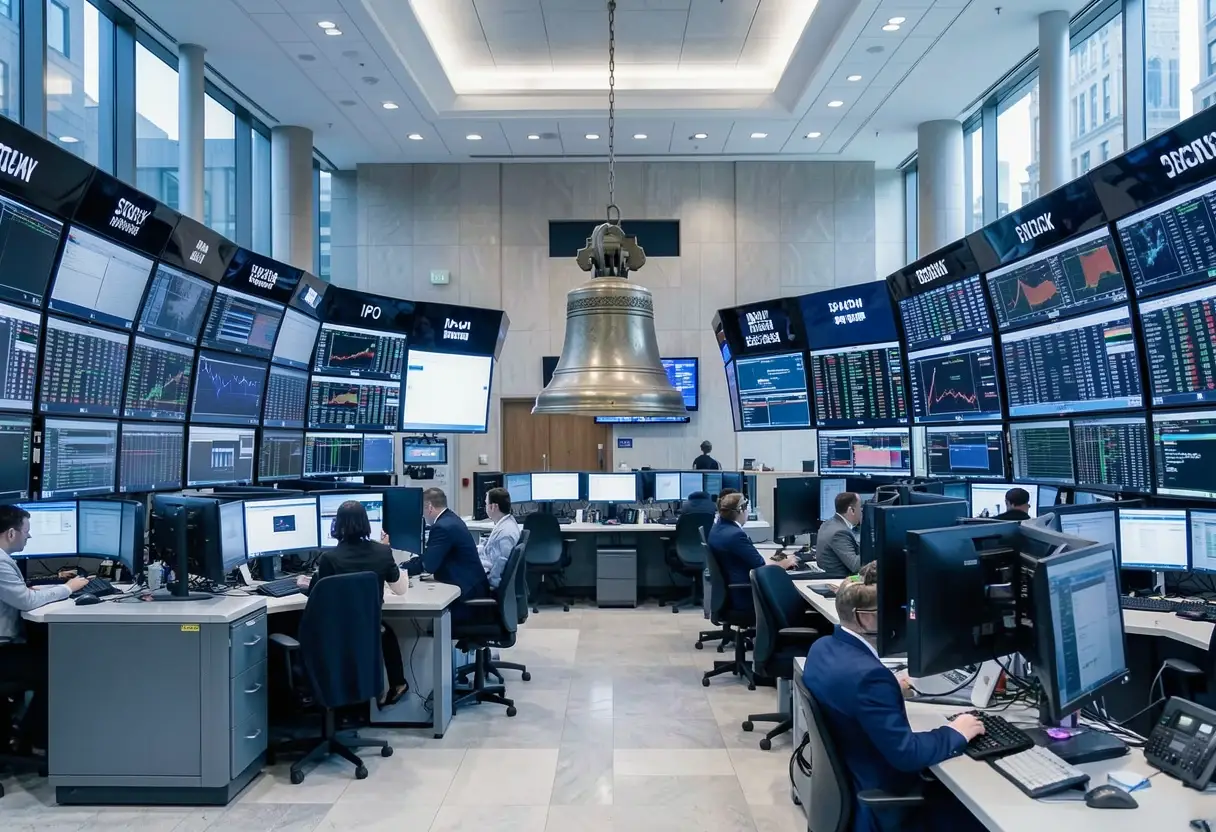
Anthropic expects to raise about $64.35 billion when it goes public Thursday — nearly twice what every U.S. IPO raised combined last quarter, per Renaissance Capital. Yet Capital Economics wrote Monday that the AI stock boom is already "in its final stages," and the U.S. economy has surprisingly little to show for it.
The numbers explain the tension. GDP grew at a 3.4% annual rate in the third quarter, the BEA's advance estimate shows, while employers added an average of just 48,000 jobs a month over the 12 months through September — before a 165,000 jump in October. Goldman Sachs estimates AI spending drove more than half of business-investment growth across the first three quarters of the year. Strip out the boom and you're left with the jobless half of what Goldman called "jobless growth."
J.P. Morgan Asset Management's David Kelly already sees real GDP slowing to 1.6% over the next four quarters, with hiring stuck near 50,000 a month.
Is the IPO market losing its appetite?
Capital Economics markets economist Joe Maher pointed to falling share issuance and "investors' waning appetite for new shares of AI-firms at lofty valuations." Anthropic, he wrote, is "a key test."
The demand math is sobering, too. Kelly calculates that two years of 2.3% growth "should have led to a monthly gain of roughly 155,000 net new jobs." The economy delivered 48,000. He blames "a lack of available workers due to a sharp reversal of immigration policy."
Morgan Stanley's Monday digest, summarizing chief U.S. economist Michael Gapen's 2027 outlook, puts the breakeven — the hiring pace needed just to keep unemployment stable — at about 50,000 jobs a month. Federal Reserve economists Seth Murray and Ivan Vidangos think labor force growth "could be near-zero starting this year," which would push that breakeven near zero as well. In that case, potential GDP growth "will need to come entirely from productivity growth." Put simply, the economy needs AI to deliver.
Where did the growth actually go?
A lot of it went overseas. Goldman estimates AI investment will add 0.6 percentage points to "true" GDP growth in 2027 but only 0.2 points to measured GDP, because official data undercounts chips and nets out imported servers.
Morgan Stanley is more upbeat: Gapen sees hyperscalers spending $1.6 trillion on capex in 2027, adding 0.9 points to growth. Goldman Sachs and Morgan Stanley — the first two of 22 underwriters on Anthropic's prospectus — project 2027 growth of 2.4% and 2.5% respectively, against JPMAM's 1.6%. Even Gapen concedes AI money is mostly propping up upper-income households while low- and middle-income consumers lead the slowdown.
Wall Street's appetite for Anthropic itself looks intact. Bloomberg reported Nov. 12 the deal was about six times oversubscribed — days after Jensen Huang resigned as Nvidia CEO. Nvidia is still buying about $10 billion of Anthropic stock in a private placement alongside the offering.
What about everyone else?
Goldman calls this a "low-hire, low-fire" job market, a phrase Jerome Powell made famous. Employers hired at a 3.4% rate in September, per the JOLTS report. Unemployment for 20- to 24-year-olds hit 7.5% in October versus 4.1% overall, and Stanford's Digital Economy Lab found in August that employment of 22- to 25-year-olds in the most AI-exposed jobs runs about 19% below pace with less-exposed peers.
Pay isn't keeping up. Average hourly earnings rose 3.1% through October, but JPMAM notes real wage growth "has been negative for seven consecutive months." Nonfarm productivity grew at a 3.6% annual rate in Q3, the BLS said Nov. 5, while labor's share of output fell to 53.0% — the lowest since the series began in 1947. AI investment "appear[s] to be contributing" to the gains, Indeed Hiring Lab's Aubrey Woessner wrote, though "increased labor productivity has not yet translated into higher real pay."
The sharpest evidence comes from Apollo economists Sania Edlich and Torsten Slok, who sorted occupations by how heavily their tasks appear in Claude conversations using Anthropic's Economic Index. Since 2023, real wage growth in the most-exposed occupations ran about 6.7 percentage points behind less-exposed jobs — with no significant employment effect. The lowest wage quartile took a 10.7-point hit. "The first measurable labor market effect of AI adoption has been wage compression rather than employment displacement," they wrote, covering about 5.8 million workers, though the period "may be partially confounded by post-pandemic labor market dynamics."
Indeed data cuts the other way: advertised salaries in the most AI-exposed occupations are up 46% since 2021 versus 25% for the least exposed — but that measures offers, not incumbent pay.
Consumers can tell the difference. Michigan's preliminary November sentiment index read 51.0, with "about 57%" spontaneously citing eroded living standards, survey director Joanne Hsu wrote. Goldman expects the low-hire, low-fire market to hold about another year "before AI displacement begins to have a larger impact in subsequent years." The boom may be ending; its labor bill is just arriving.
Audit trail
- Anthropic's IPO, priced at the top of its range, would raise about $64.35 billion — nearly double all U.S. IPO proceeds last quarter, per Renaissance Capital.
- GDP grew at a 3.4% annual rate in Q3 while payrolls averaged 48,000 jobs a month over the 12 months through September.
- Apollo economists found real wage growth in the most AI-exposed occupations ran 6.7 points behind less-exposed jobs since 2023, affecting about 5.8 million workers.
- Labor's share of nonfarm output fell to 53.0% in Q3, the lowest since the data series began in 1947.
- Michigan's preliminary November consumer sentiment index stood at 51.0, with 57% citing eroded living standards.
via fortune.com/feed/ (Source)
More from Grace Kim
Show full bio
Staff writer covering people, launches and day-to-day practice in corporate finance and the leaders who run it at CFO Observer.
301 articles
Cross-references
- AI stocks slide after Anthropic’s record $81.34 billion IPO
- Fed Poised to Hike Into AI Boom It Can't Cool — Main Street Pays
- Fund Managers Cut Tech Exposure Most Since 2006 as AI Profit Boom Peaks
- AI Could Shrink Deal Teams From Four to Two, Eroding Junior Pipeline
- S&P 500 to Sit 12% Lower by End-2027 as AI Capex Rolls Over, Economists Say