RefE-329
Entered
Figures4 min · 753 words
Working paper
RadNet Q3 Revenue Climbs 22% to $638 Million, Guidance Raised
RadNet's Q3 revenue rose 22.1% to $638.3 million, adjusted EBITDA gained 23.8% to $105 million, and management raised 2026 imaging center guidance on strong demand.
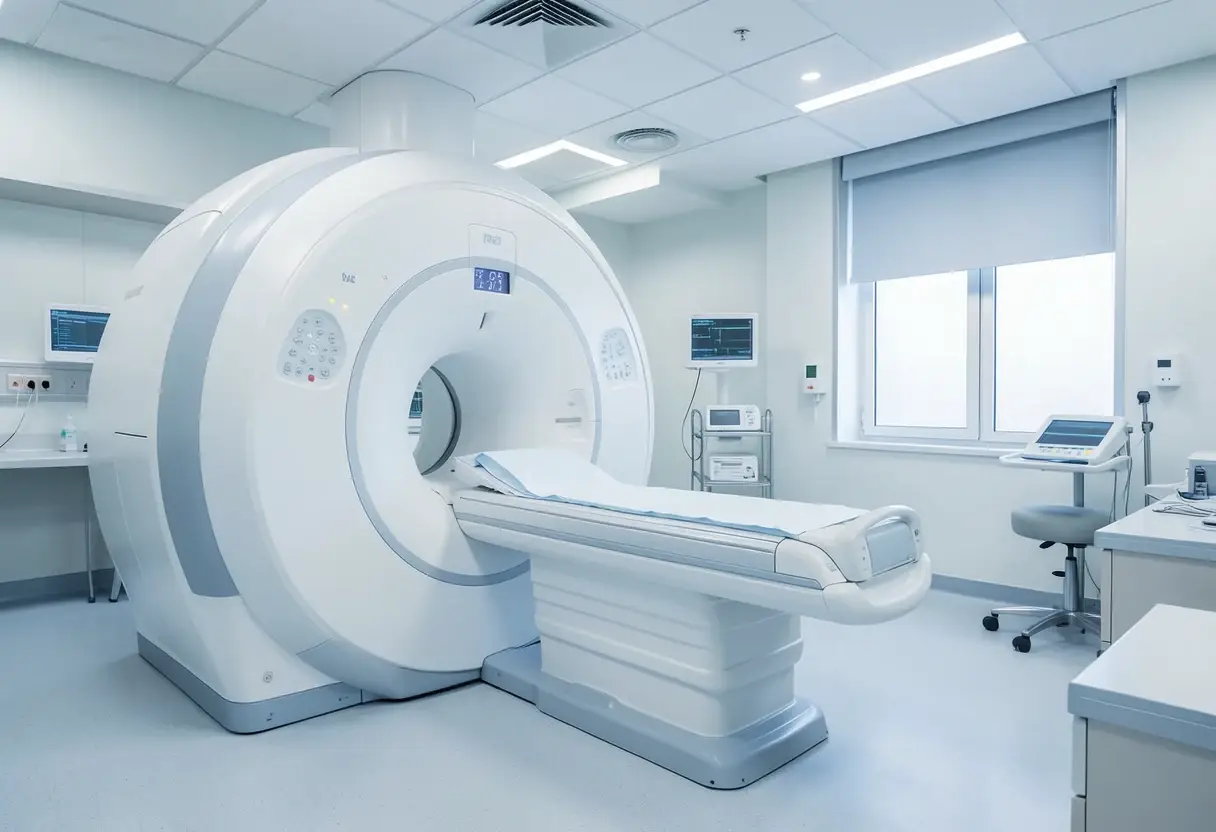
RadNet grew third-quarter revenue 22.1% to $638.3 million from $522.9 million a year earlier, with adjusted EBITDA up 23.8% to $105 million and adjusted diluted EPS rising to $0.30 from $0.24. That's the hardest fact of the quarter, and CEO Howard Berger delivered it on the earnings call alongside a raised full-year outlook for the imaging center business.
Berger credited capacity expansion at existing centers, new openings, acquisitions, higher commercial reimbursement (what insurers pay providers) and a widening network of health system partnerships. RadNet ended the quarter with 439 centers, 161 of them held in health system partnerships.
The takeaway in plain words: growth came from doing more scans, at better rates, in more places.
What's driving procedure volume?
CFO Mark Stolper reported aggregate procedure volume up 10.8%, with same-center volume up 3.2%. Advanced imaging — MRI, CT and PET/CT — made up 30.6% of total procedures, up from 28.2% a year earlier, and grew faster than routine imaging.
Imaging center adjusted EBITDA rose 25.3% to $102 million despite continued pressure on technologist and radiologist salaries. Stolper pointed to faster MRI scanners, remote technologists and operational changes as capacity levers. Prostate PSMA and brain amyloid studies represented nearly 26% of PET/CT volume in the quarter.
Berger noted newer PET/CT scanners finish a scan in under 15 minutes versus an hour previously, and flagged CT coronary angiography and breast MRI as growth areas. His framing of the challenge: RadNet needs to add enough capacity to meet demand.
Roughly 13% of MRI exams used remote technologists through the TechLive program, and RadNet plans to expand that to ease staffing shortages and cut exam room closures. Volume, mix and throughput are all moving the right way.
How fast is Digital Health scaling?
Digital Health revenue rose 33% to $32.9 million, including $21.4 million from customers outside RadNet. Segment adjusted EBITDA slipped to $3 million from $3.5 million, reflecting investment in commercial and implementation staff plus temporary dilution from acquisitions, management said.
The pipeline is the real story. Segment president and CEO Kees Wesdorp said Digital Health closed roughly $71 million in total contract value during the quarter, including an approximately $53 million long-term agreement with a U.S. teleradiology provider covering enterprise informatics and clinical AI products.
Annual recurring revenue ended the quarter at $112.6 million, up 67% year over year. Wesdorp said the segment is on track to exceed $140 million by year-end and expects fourth-quarter revenue to rise about 20% sequentially as customer implementations come online.
Sham Sokka, chief operating and technology officer, said the Reporting Pro product now covers more than 30% of RadNet's exams, with full deployment targeted by the end of Q1 2027 and automation of reports for over 50% of imaging volume targeted by Q3 2027. In short: near-term margin dilution is buying a much larger contracted revenue base.
What did guidance and the ONRAD deal change?
RadNet raised 2026 imaging center revenue guidance by $15 million at both ends to $2.385 billion–$2.435 billion, lifted segment adjusted EBITDA guidance by $5 million at both ends to $350 million–$363 million, and raised free cash flow guidance to $120 million–$130 million.
Digital Health revenue guidance was reaffirmed at $135 million–$145 million. Wesdorp gave a segment adjusted EBITDA range of $10 million–$13 million; Stolper later cited $11 million–$13 million before non-capitalized research and development.
The pending ONRAD acquisition will create a third reportable segment, Radiology Professional Services. Berger said ONRAD has more than 130 contracted radiologists serving over 225 hospitals across 26 states, and RadNet expects it to contribute $190 million–$200 million in revenue and $60 million–$65 million in adjusted EBITDA in its first year after closing.
Stolper detailed the price: $350 million in cash plus 5 million shares at closing, with an earnout paying 15 times each dollar of ONRAD's 2027 EBITDA above $56 million, in cash or stock at RadNet's election.
On reimbursement, Stolper estimated the final 2027 Medicare physician fee schedule would cut RadNet's revenue by roughly $5 million; he noted Congress could still act to change the reduction.
RadNet ended the quarter with $750.6 million in cash and net debt-to-adjusted EBITDA (leverage) of 1.66 times, with management planning continued investment in capacity, acquisitions and health system partnerships. The balance sheet has room to keep consolidating.
Audit trail
- Q3 revenue rose 22.1% to $638.3 million; adjusted EBITDA up 23.8% to $105 million.
- Digital Health annual recurring revenue reached $112.6 million, up 67% year over year.
- RadNet raised 2026 imaging center revenue guidance to $2.385–$2.435 billion.
- ONRAD deal: $350 million cash plus 5 million shares, with a 15x earnout above $56 million of 2027 EBITDA.
- Net debt-to-adjusted EBITDA stood at 1.66 times with $750.6 million in cash.
via dailypolitical.com (Source)
More from Grace Kim
Show full bio
Staff writer covering people, launches and day-to-day practice in corporate finance and the leaders who run it at CFO Observer.
135 articles
Cross-references
- Radian Q3 revenue doubles as adjusted EPS beats forecasts
- Encompass Health Lifts 2026 Guidance as Adjusted EPS Rises 23.6%
- Concentra lifts 2026 outlook as visits and pricing lift profit
- Astrana Health Holds 2026 Outlook as Medicaid Attrition Bites
- Mesa Laboratories Guides to $250 Million Revenue and $40 Million Buyback