Entered
Figures5 min · 925 words
Working paper
Delta chief blames human error and faulty gear for FAA halt
Roughly 12,500 flights were canceled on Friday as the FAA halted departures nationwide for over four hours. Delta's CEO blames human error and faulty equipment, not AI or cyberattack.
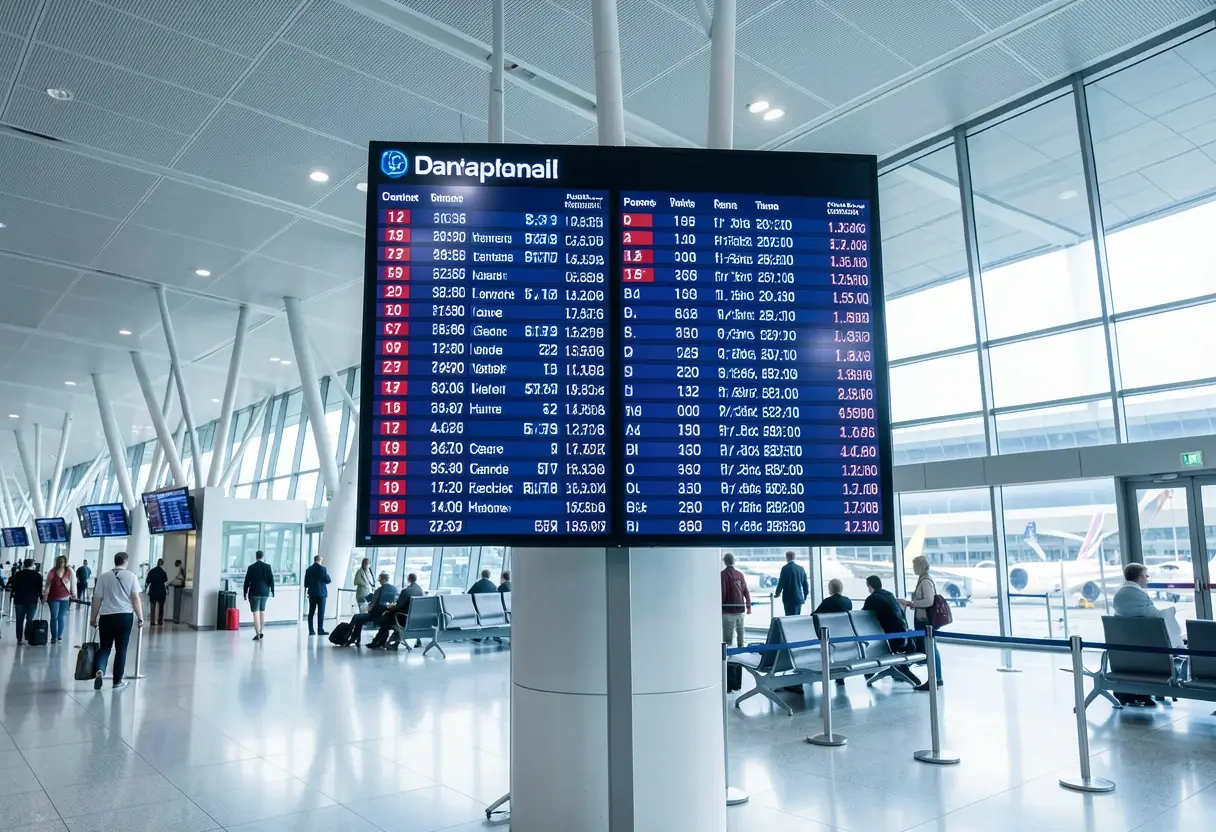
Roughly 12,500 flights were canceled on Friday after the Federal Aviation Administration halted departures nationwide for more than four hours. Delta Air Lines CEO Ed Bastian attributes the disruption to "a combination of faulty equipment, coupled with human error," and puts the cost of the mess "in the billions."
Speaking with Fortune's Alyson Shontell at the Fortune 500 Innovation Forum in Detroit, Bastian dismissed the more fashionable theories. "There's no evidence that there's [an] AI trigger. There's no evidence that there's cyber at play," he said. He added that he has no information beyond what has been reported: "We'll find out when it comes in."
The stop was the first nationwide halt since a January 2023 system outage, and only the second since 9/11. Saturday brought thousands of additional cancellations. A detail worth savoring for anyone auditing infrastructure risk: this required both aging copper and new fiber to fail in coordination.
What does the investigation show?
Transportation Secretary Sean Duffy, whom Bastian has spoken with along with FAA Administrator Bryan Bedford, has been "very transparent," the CEO said. The trouble began during a copper-to-fiber switch at an FAA radio site in El Dorado, Ark. A router at a radar site in Amarillo, Texas, then "started to flood our system," according to Duffy.
Contractor L3Harris performed the installation and says it is supporting the investigation. Duffy has asked publicly whether the fault lay in the install or in the router itself. Bedford, for his part, reported "zero evidence of anything nefarious and zero evidence of anything AI related." Reassuring, if faintly exhausting that it needed saying.
Bastian noted the router work was routine. "I think they've replaced, I understand, close to 70% of the routers already," he said; L3Harris puts the fiber switch at more than 70% complete. "So I don't know. I can't explain it." The system recovered once the offending routers were taken offline, but finding them "took hours." Asked whether more nationwide stops are coming, he called Friday "clearly an anomaly" and refused to extrapolate "until we know what happened."
Where does the $50 billion pitch stand?
Bastian converted the outage into a budget argument. Investors are pouring "hundreds of billions, if not trillions of dollars" into AI and data centers, he said, while "we can't even get $50 billion to fix our skies." Congress approved $12.5 billion for air traffic control last year. Duffy wants $50 billion on top of that; President Trump has asked for $30 billion. The negotiation, one notes, has structure.
"The terrible thing would be if we use this instance to 'lose confidence in what we're doing," Bastian said. He also observed that flying from Atlanta to LaGuardia takes longer today than when Delta launched the route in the 1950s, and argued that more capacity is the only route to lower fares. "We're congested, we're gridlocked."
How is Delta's business holding up?
Delta's profit this year will be "pretty similar" to last year's despite a $6 billion jump in its fuel bill, Bastian said. Ticket prices are up 15% to 20% year-over-year, a move he described with open amazement: "We have never seen that dramatic growth." Adjusted revenue rose 16% in the third quarter, and Delta expects roughly 20% growth in the fourth.
The airline could raise prices or cut flights; Bastian argues that "people are willing to pay more rather than have their options limited." Most of Delta's customers, he said, live "in the upper end of the K," a reference to the K-shaped economy, in which wealthier households gain while others stagnate.
A planned Delta route to Riyadh, first revealed at the Fortune Global Forum in October 2025, was pushed back after missile attacks on the Riyadh airport. Service had not yet started when the airport was hit, Bastian said.
What about Musk, Wi-Fi and AI?
Elon Musk has attacked Delta on X since the airline chose Amazon's Leo satellite service over SpaceX's Starlink. In early October he posted that Bastian "will lose his job over this" and that "Delta will lose a lot of customers." He also joked that a Delta flight was a good place to test an AI model, given the absence of internet.
Bastian's response was diplomatic. Delta "helped them get started in aviation," lending SpaceX planes for testing during COVID, but "we just couldn't come to an agreement on a business model." Customers do not choose airlines on Wi-Fi, he said, and when Leo arrives — slated for 500 Delta planes starting in 2028 — "we'll be at least as good as Starlink, if not better." United, meanwhile, is already installing Starlink across its fleet.
Leo has a fresh problem of its own. On Sunday, a United Launch Alliance Vulcan rocket failed to reach orbit and lost all 40 Amazon Leo satellites it carried; Amazon had about 400 in orbit beforehand.
On AI, Bastian repeated that the technology serves Delta's roughly 100,000 workers rather than replacing them. "I'm not getting on any planes operated by AI with one pilot," he said. He has previously told Fortune he dislikes the term AI and prefers "augmented intelligence." Callers, he noted, never praise it: "They always complain about the AI." Trust, in his view, is the technology's largest U.S. problem. Workers whose roles change will be moved "to the extent capable into service, at airports or on the phones."
Audit trail
- Friday's FAA ground stop lasted more than four hours and canceled roughly 12,500 flights, with thousands more canceled Saturday.
- Bastian puts the disruption cost 'in the billions' and blames faulty equipment plus human error.
- Congress approved $12.5 billion for air traffic control last year; Duffy seeks $50 billion more, Trump $30 billion.
- Delta's ticket prices rose 15% to 20% year-over-year despite a $6 billion fuel bill increase.
- A Vulcan rocket failure on Sunday lost all 40 Amazon Leo satellites destined for Delta's fleet from 2028.
via fortune.com/feed/ (Source)
More from Sophie Lindqvist
Show full bio
Market editor covering technology and product news in corporate finance and the leaders who run it at CFO Observer.
261 articles
Cross-references
- Honeywell CEO: 50 Years of Automation Have Outgrown Their Operators
- FAA Ground Stop Probe Focuses on Router Flood, Not Hack, Duffy Says
- FAA Ground Stop Canceled 17,850 Flights and the Bill Is Coming
- FAA Ground Stop Traced to Router Flood: 1,000 Attempts Every Four Seconds
- FEMA Officials Pull Extra Cash as Outage Wave Rattles Agencies